
What is SCAMPER technique?
Learn this innovative technique to come up with killer ideas for your next venture

SCAMPER Technique: Sparking Innovation through Transformation
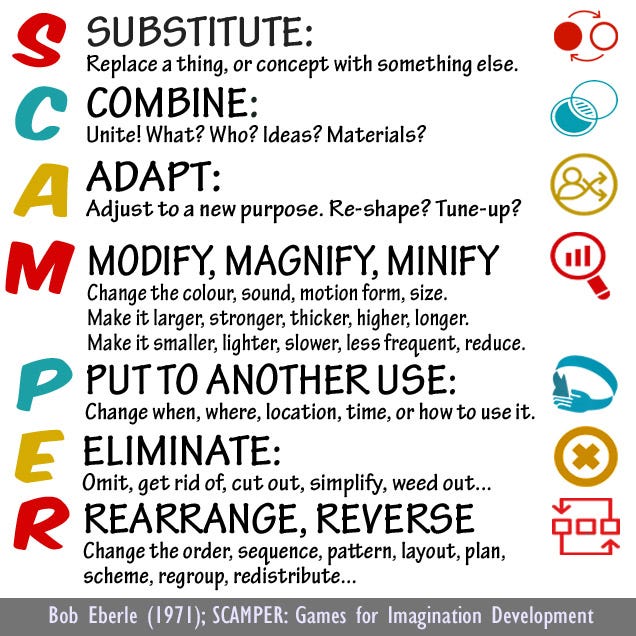
The SCAMPER technique is a structured approach to idea generation that involves applying different strategies to your existing concept to generate new variations or possibilities. Each letter in "SCAMPER" represents a strategy that can be applied to your idea.
S - Substitute: Consider substituting a component, material, or process in your idea with something else. For example, if you're designing a new type of water bottle, you could substitute the traditional screw cap with a magnetic closure.
C - Combine: Explore opportunities to combine elements from different concepts or industries. For instance, if you're creating a fitness app, consider combining features from social networking platforms to foster a sense of community among users.
A - Adapt: Look at your idea from a different angle or perspective. How might it be adapted for a different target audience, context, or environment? If you're developing a productivity tool for professionals, think about how it could be adapted for students.
M - Modify: Consider modifying existing elements of your idea to enhance or alter their functionality. For instance, if you're designing a backpack, think about how you could modify the straps for improved comfort and adjustability.
P - Put to Another Use: Explore alternative applications for your idea. If you're creating a smart home device, think about how its technology could be put to use in a different setting, such as healthcare.
E - Eliminate: Identify components, features, or processes that could be eliminated without sacrificing the core functionality. This can lead to streamlined and more efficient designs.
R - Reverse: Consider reversing elements or processes in your idea. How might reversing the order of steps or the direction of a process lead to a novel solution?
Advantages of using SCAMPER technique
Structured Creativity: SCAMPER provides a systematic framework for exploring innovative variations of your idea.
Promotes Innovation: By prompting you to consider different angles and modifications, SCAMPER can lead to creative breakthroughs.
Enhances Problem Solving: SCAMPER can help you find solutions to challenges or limitations within your original concept.
Incorporating techniques like mind mapping and SCAMPER into your ideation process can enhance your ability to generate diverse and innovative ideas. These approaches encourage both creative thinking and structured exploration, allowing you to uncover unique possibilities that might otherwise remain hidden.
Let's explore a real-life example of how the SCAMPER method was used to spark innovation and create a successful product: the evolution of the Post-it Note.
The Evolution of the Post-it Note: A SCAMPER Success Story
S - Substitute: In the early 1970s, Dr. Spencer Silver, a chemist at 3M, was attempting to create a super-strong adhesive. However, he accidentally developed a weak, reusable adhesive that stuck to surfaces but could easily be removed without leaving residue. This weak adhesive was initially seen as a substitute for stronger adhesives in applications like bulletin boards.
C - Combine: A few years later, a fellow 3M scientist named Art Fry attended a seminar where he was frustrated by the slipping bookmarks in his hymnbook. He combined the weak adhesive with small, colored pieces of paper to create bookmarks that could stay in place without damaging the pages.
A - Adapt: Recognizing the adaptability of the weak adhesive, Fry realized that it could be used to create temporary labels that could be easily removed. He adapted the concept of traditional labels and transformed it into a more versatile and user-friendly solution.
M - Modify: In the process of modifying the concept, the original idea of bookmarks evolved into small, rectangular pieces of paper that could be used for jotting down notes and sticking them to various surfaces. This modification transformed the weak adhesive into a tool for organization and communication.
P - Put to Another Use: As the modified concept gained traction within 3M, it was clear that the innovation could be put to another use entirely—creating a new product category. Instead of being limited to bookmarks, the new adhesive-backed paper found a broader purpose in the realm of personal and professional organization.
E - Eliminate: One of the key aspects of the Post-it Note's success was its ability to eliminate the need for permanent adhesive solutions like tape and glue for temporary tasks. It eliminated the residue and damage associated with traditional adhesives, offering a cleaner and more convenient solution.
R - Reverse: The reverse application of the original super-strong adhesive goal led to the creation of an adhesive that was intentionally weak. This reverse approach ultimately revolutionized the way people stuck notes to surfaces.
The Impact
The evolution of the Post-it Note exemplifies the power of the SCAMPER method in sparking innovation. What began as an accidental discovery of a weak adhesive eventually transformed into a ubiquitous and highly successful product. The simple combination of weak adhesive with colored paper was adapted and modified to create a versatile tool for organization and communication. By eliminating the need for permanent adhesives and reversing the original adhesive objective, the Post-it Note revolutionized the way people interacted with notes and messages.
Conclusion
The Post-it Note is a testament to the SCAMPER method's ability to generate innovative ideas by prompting creative exploration and transformation. This case study showcases how a seemingly small and accidental innovation, when subjected to the SCAMPER lens, can lead to the creation of a product that has become an integral part of modern personal and professional life. The SCAMPER technique encourages thinking outside the box, considering various perspectives, and adapting existing ideas to new contexts, ultimately fostering innovative breakthroughs.